Contract and Compliance Management System (CCMS)
Designing and evolving an enterprise platform that helps legal teams manage contracts, compliance, disputes, and everyday legal workflows in one place.
TL;DR
- Product Designer (Collaborative team of 2 designers)
- July 2025 – Present
- Enterprise Web Application
- LegalTech / B2B SaaS
- Live
The story in 30 seconds
Problem
Managing all these responsibilities across different tools can make it difficult to stay organised, track progress, and maintain accountability.
Goal
Make complex legal processes easier to manage without compromising the depth and structure that legal professionals need.
Result
CCMS has progressed from its initial development into a live product being used by customers.
01 — Overview
One platform for managing legal operations
Legal departments handle a lot: contracts, regulatory obligations, disputes, board meetings, deadlines, and internal collaboration.
CCMS (Contract and Compliance Management System) is an enterprise legal operations platform designed to bring these activities into one centralised workspace.
I joined the project in July 2025 as part of a two-person product design team, working alongside product stakeholders and developers to translate complex legal requirements into usable digital experiences.
The product has since launched and is being used by customers. Following client engagements and feedback gathered during a conference, we are continuing to improve existing workflows and expand its capabilities.
02 — The Problem
Legal work is complex. Managing it shouldn’t be.
Read more
In-house legal teams are responsible for numerous activities, often involving different people, departments, documents, and deadlines.
When information is scattered, several challenges emerge.
- 01
Scattered information
Contracts, legal documents, and compliance records are stored across different platforms, making information difficult to access.
- 02
Missed deadlines
Tracking contract milestones, regulatory renewals, and legal activities manually increases the risk of overlooking important dates.
- 03
Unclear responsibilities
Without structured assignments, it becomes difficult to know who owns a task or how far the work has progressed.
- 04
Limited visibility
Legal leadership needs a clear picture of ongoing activities, outstanding obligations, and potential risks.
03 — Understanding the Users
Different roles. Different priorities. One platform.
- Head of LegalWhat they needOversight of legal activities, team assignments, and risks
- Legal OfficersWhat they needEasy access to assigned work, documents, and deadlines
- Compliance OfficersWhat they needVisibility into regulatory requirements and renewals
- Team LeadsWhat they needAbility to manage team workloads and responsibilities
- Board MembersWhat they needAccess to relevant meetings, documents, and decisions
- AdministratorsWhat they needControl over users, permissions, and settings
We needed to consider what each user should see, what actions they could perform, and how their responsibilities connected to other users.
Read more
One of our biggest considerations was designing for users with different responsibilities and levels of access.
This meant we couldn’t design a one-size-fits-all experience.
04 — Our Design Approach
Making complex workflows feel simple
Our design approach focused on three key principles.
Clarity over complexity
We wanted users to understand where they were, what information was important, and what action to take next.
Consistency across modules
Although contract management and dispute resolution involve different processes, common interactions should feel familiar.
- 01Contract Management
- 02Compliance Management
- 03Pre-Litigation Matters
- 04Litigation Management
Visibility and accountability
The system needed to communicate more than just stored information.
Read more
CCMS contains multiple modules, each with its own processes, data, and user interactions.
Clarity over complexity. This influenced how information was grouped into dashboards, tables, detail pages, and structured forms.
Consistency across modules. Reusable patterns for assignments, status indicators, documents, tasks, and navigation help create a more predictable experience.
Visibility and accountability. Users should be able to identify responsibilities, upcoming deadlines, current statuses, and the progress of ongoing activities.
05 — The Solution
Bringing legal operations into one connected experience
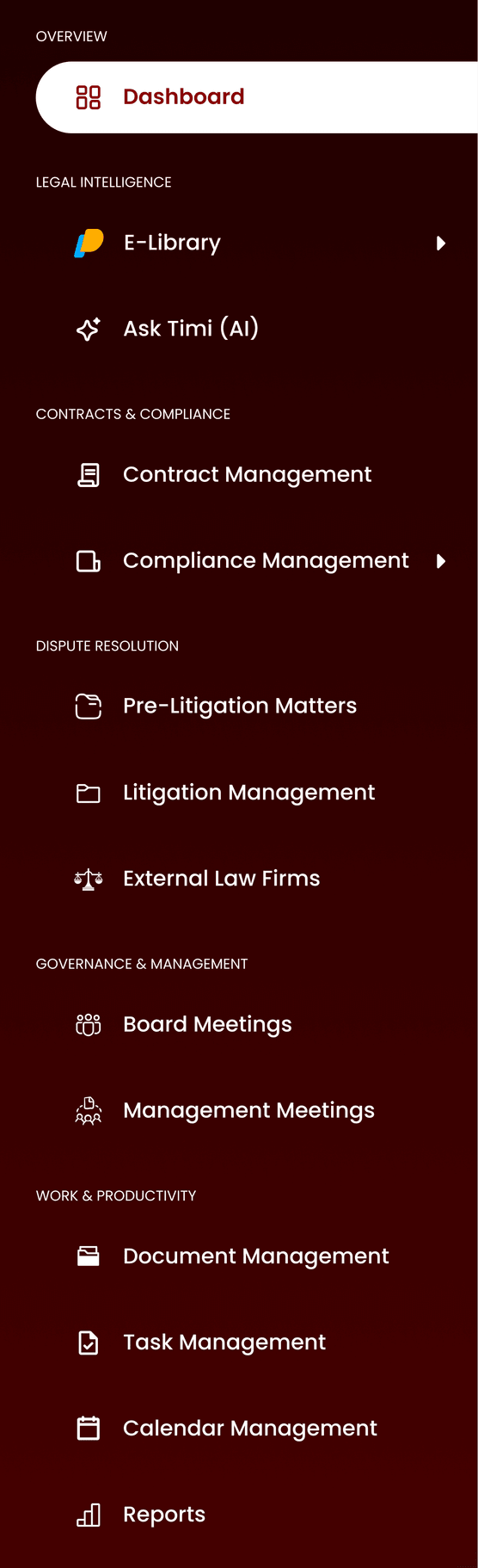
Rather than designing separate tools for each legal function, CCMS brings related workflows into one platform. The design covers several major areas.
01Dashboard
Centralised Dashboard
Giving legal teams a clearer view of their responsibilities.
Provides real-time visibility into all areas of legal operations, enabling proactive management and informed decision-making.
Read more
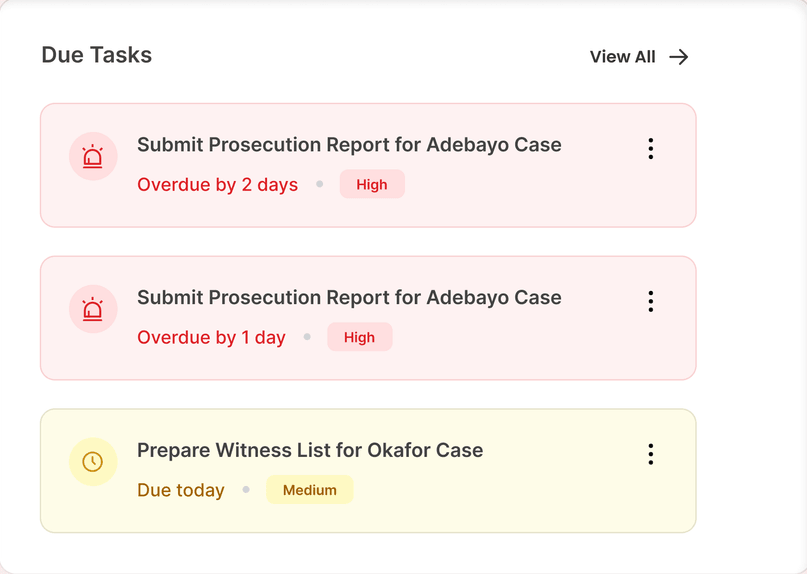
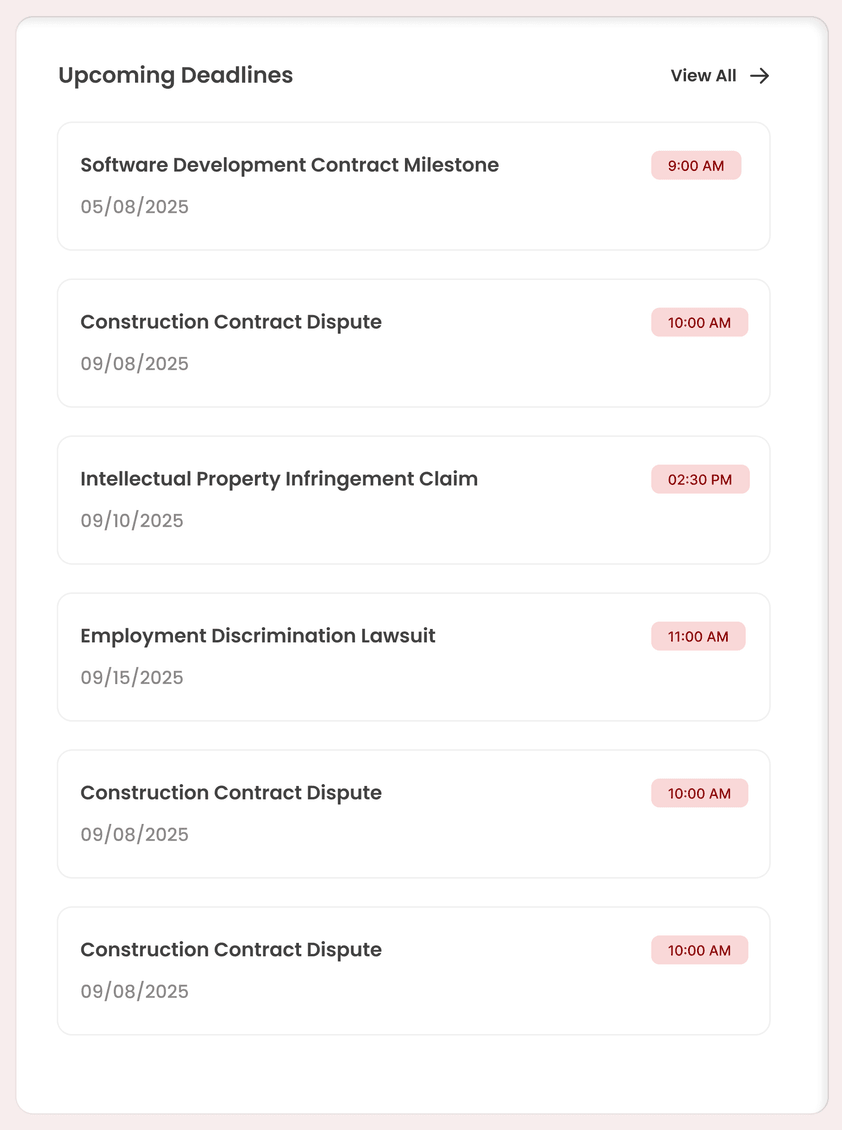
The dashboard brings important legal activities into one overview, helping users monitor contracts, compliance obligations, disputes, upcoming deadlines, and tasks requiring attention.
The experience prioritises visibility through summary cards, status indicators, tables, and upcoming activities.
02E-Library · Ask Timi (AI)
Legal Intelligence
Together, these capabilities provide legal professionals with digital research resources and AI-assisted tools to improve access to legal knowledge and support legal work.
E-Library State Laws Regulations of MDAs Nigeria Regulatory Agencies Ask Timi (AI) 03Contract Management
Contract Management
Making contract activities easier to organise and monitor.
Provides a structured environment for managing contracts throughout their lifecycle, from inception to conclusion.
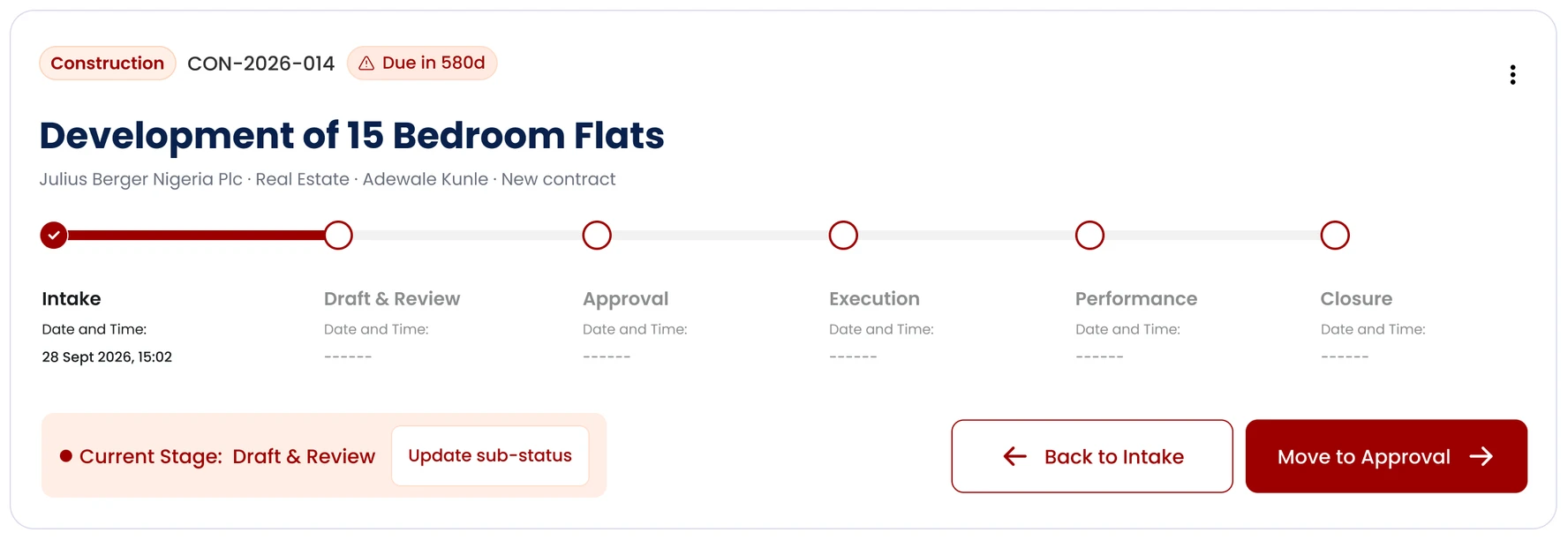
Option A: Create a New Contract
This initiates a contract workflow beginning with intake and progressing through drafting and review, approval, execution, performance and closure.
- Intake
- Draft & Review
- Approval
- Execution
- Performance
- Closure
Option B: Register an Executed Contract
This allows a user to register an agreement that has already been executed.
- Intake / Registration
- Execution — recorded as completed
- Performance
- Closure
Contract Management Create New Contract Add Party(ies) Overview Terms & Clauses Tasks Milestones Disputes Read more
The contract management experience supports registering contracts, assigning responsible counsel, managing contract parties, uploading documents, and tracking milestones.
Contract details are organised to help users understand the agreement, its current status, key obligations, and upcoming activities.
The product is also evolving toward broader lifecycle management, including drafting, review, approval, execution, and performance monitoring.
04Compliance Management
Compliance Management
Helping organisations stay ahead of regulatory obligations.
Provides tools for documenting, organising and monitoring the organisation’s regulatory and compliance responsibilities.
- Regulatory Source
- Compliance Requirement
- Compliance Cycle
- Work
- Evidence
- Outcome
- History
- Insight
Compliance Management
- Regulatory Requirements
- Organization's Repository
- Agency Register
- Audit Trail
Regulatory Requirements
Regulatory Requirements Annual Corporate Filing Compliance History Organization’s Repository
E-Library Corporate Affairs Commission (CAC) Organisational Uploads Agency Register
Read more
The compliance module enables legal teams to register requirements, assign responsibilities, track deadlines, and maintain supporting documentation.
The newer experience expands this into a dedicated workspace for each requirement, connecting preparation tasks, evidence, internal deadlines, compliance history, and insights.
It also introduces more intelligent regulatory monitoring and AI-assisted identification of compliance obligations.
05Pre-Litigation Matters
Dispute and Matter Management
Bringing structure to complex legal matters.
The Pre-Litigation Letters module will enable an organisation’s legal department to register, assign, manage, monitor and resolve letters received in connection with potential disputes before litigation.
Pre-Litigation Matters Overview Financials Read more
Legal disputes can involve several stages, documents, conversations, external lawyers, and important dates.
The platform supports organising disputes, tracking resolution activities, managing responsible counsel, and monitoring case progress.
Ongoing enhancements are extending this experience to support pre-litigation matters, formal litigation, hearings, legal expenditure, and external law firm management.
06Litigation Management
Litigation Management
Managing formal litigation matters, associated documentation, activities and relevant deadlines.
A litigation matter can be linked to any pre-litigation matter, open or closed, and to a contract of origin.
Litigation Management Create New Matter Add Party(ies) Overview Hearings 07Board Meetings · Management Meetings
Board and Governance Management
Turning decisions into trackable actions.
Provides digital tools for organising and managing the organisation’s board and management meeting activities.
Read more
The governance experience supports organising board meetings, managing relevant documents, recording decisions, and following up on assigned responsibilities.
Instead of allowing decisions to remain buried in meeting minutes, the platform connects them to actionable workflows.
08Task Management · Calendar Management
Calendar Management
The Calendar is the single consolidated view of every dated activity in CCMS: hearings, litigation deadlines, tasks, meetings, contract milestones, compliance obligations, pre-litigation deadlines and general events.
Team Management and Permissions
Ensuring the right people have access to the right information.
Read more
Because legal information can be sensitive, the experience requires clear permissions and carefully managed access.
We worked with requirements covering individual assignments, team-based responsibilities, user roles, and restricted access to specific modules.
This also meant considering how interactions change depending on the user’s authority.
For example, an action available to a Head of Legal might not be available to a Legal Officer.
06 — Designing for an Evolving Product
Launch wasn’t the finish line.
For us as designers, this meant revisiting existing experiences rather than simply designing new screens.
- Launch
- Client engagements & conference feedback
- Revisiting existing experiences
- Improvements
What this taught me
Designing for a live enterprise product requires a different mindset from designing a new concept.
- 1. Contract lifecycle management
- 2. Compliance workspaces
- 3. Dispute resolution
- 4. Team collaboration
Read more
One of the most important aspects of working on CCMS has been adapting to changing product requirements.
These changes have influenced the ongoing development of contract lifecycle management, compliance workspaces, dispute resolution, team collaboration, and other areas of the platform.
We needed to consider how changes would affect existing workflows, maintain consistency, and fit into a platform that customers were already using.
Every improvement has to consider existing users, established workflows, technical dependencies, and the long-term direction of the product.
07 — Challenges and Design Decisions
Balancing complexity with usability
Managing information-heavy interfaces
Legal workflows involve extensive details, documents, deadlines, and activities. The challenge was to organise this information so users could focus on what mattered without losing access to important context.
Supporting multiple user roles
Permissions and responsibilities vary significantly between users. This required careful consideration of action visibility, navigation, and role-specific interactions.
Maintaining consistency as the product grew
With multiple modules and evolving requirements, shared interaction patterns became important for keeping the experience cohesive.
Adapting to feedback
As new requirements emerged, we had to consider how proposed improvements would affect existing experiences rather than designing each enhancement in isolation.
Read more
Working on CCMS presented several design challenges.
These challenges reinforced the importance of designing systems that are not only usable today but flexible enough to evolve.
08 — Outcomes and Impact
From product design to a live enterprise application
Some important project milestones include:
Product launched
CCMS has been released into the market and has active users.
Core legal workflows brought together
Contract management, compliance tracking, governance, dispute management, and related activities are supported within one platform.
Real-world feedback gathered
Client engagement and conference feedback have provided direction for further product improvements.
Continuous development
The team is implementing enhancements to better support legal workflows and evolving organisational requirements.
Read more
The project has delivered a centralised environment for managing key legal operations, while ongoing improvements continue to expand its functionality.
As the product continues to evolve, further opportunities remain to assess how these changes improve usability, operational efficiency, and user satisfaction.
09 — What I Learned
Designing enterprise products is about more than designing interfaces.
Complex problems need structured thinking.
Breaking down detailed legal requirements into understandable workflows is essential to making the experience manageable.
Consistency becomes more important as products scale.
Shared patterns and components help keep a growing platform familiar and predictable.
Different users need different experiences.
Designing around roles and responsibilities makes the product more relevant to the people using it.
Products continue evolving after launch.
Feedback, changing business needs, and technical considerations make iteration an important part of the design process.
Read more
Working on CCMS has strengthened my understanding of what it takes to design a complex product that supports real organisational processes.
Most importantly, this project has reinforced my understanding that
“good enterprise design isn’t about removing complexity from the business. It’s about making that complexity easier for people to work with.”
10 — What’s Next?
Current areas of product evolution include more comprehensive contract lifecycle workflows, enhanced compliance management, expanded dispute and litigation capabilities, and deeper integration of AI-assisted legal tools.
As part of the design team, I continue to contribute to the ongoing evolution of the experience, with a focus on maintaining clarity, consistency, and usability as the product grows.
Read more
Final Reflection
CCMS has been an opportunity to work on a complex enterprise product across its development, launch, and continuous improvement.
Beyond designing interfaces, the experience has helped me better understand how to translate specialised business requirements into structured digital experiences, collaborate within a product team, and approach design as an evolving process.
The goal has remained consistent: making complex legal operations easier to understand, manage, and act on.